I hadn’t been to Stonehenge for the summer solstice since 2008, so this year I decided it was finally time to go back.
I started the day at Avebury Stone Circle, spending the afternoon there before making my way towards Stonehenge later in the day. I’d expected the roads to be absolutely horrendous with so many people heading in the same direction, but surprisingly, they weren’t nearly as busy as I’d imagined.
The drive itself takes you through a pretty extraordinary ancient landscape. On the way I passed Silbury Hill, my first time seeing it, which is quite something when you see it rising up beside the road. It’s the largest prehistoric man-made mound in Europe, built more than 4,000 years ago, and even now nobody really knows for certain why it was built. There’s something slightly surreal about just simply driving past something so enormous and ancient on your way from one prehistoric site to another. So cool!

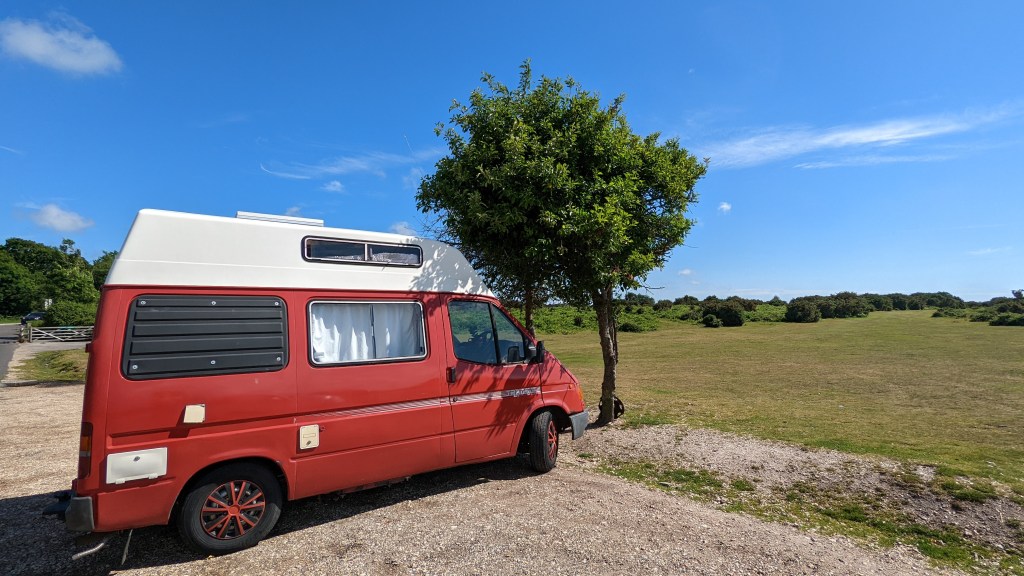
Unfortunately, somewhere between Avebury and Stonehenge, my phone decided to stop cooperating. I lost my mobile data completely! I had no 4G, no 5G, nothing, which left me travelling a little bit blind. I didn’t mind that actually. Just driving in my latest little campervan across the lands is always an adventure in itself. That’s just one of the reasons why I do so love vanlife!
Anyway, normally, having no data connection wouldn’t have mattered too much, except that to park at Stonehenge for the solstice you need to have bought a parking ticket in advance. You don’t have to pay to enter Stonehenge itself for the solstice celebrations, but you do need a parking ticket if you’re arriving by vehicle and they check your barcode before allowing you into the proper parking area and of course, my barcode was sitting in an email that I could no longer open.
When I arrived, I tried to explain the situation, but without the barcode they couldn’t sign me off and let me park properly. I was directed to another area temporarily, and from there I made my way over to the Visitor Centre, where thankfully I managed to connect to their Wi-Fi so I was then able to download my email with the barcode.
Barcode retrieved, I went back to the woman at the car park, showed her the ticket and was finally allowed through to park properly.
So, my first useful piece of advice if you’re thinking about doing the summer solstice at Stonehenge yourself: screenshot or download your parking barcode before you leave home. Don’t do what I did and assume you’ll be able to pull up the email when you get there. Mobile signal can disappear, and when thousands of people are descending on Stonehenge, that is really not the moment you want to discover that your all-important barcode is trapped somewhere in the cloud!
Once I was finally parked up, I settled into my campervan, made myself some dinner and chatted to some of the other people who were arriving. There was already a really nice atmosphere in the car park, with campervans and cars steadily turning up and people getting themselves ready for the night ahead.
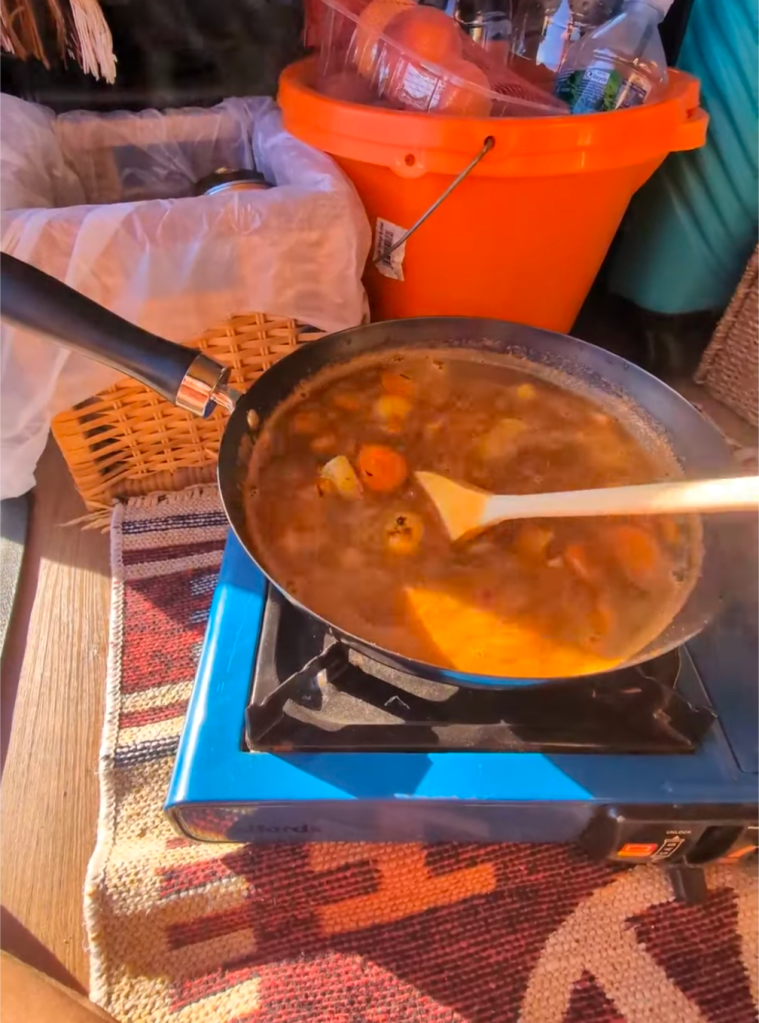
As the sun began to set, I decided it was time to make my way towards the monument.
There are two ways to get from the Visitor Centre and car park to Stonehenge. You can take one of the free shuttle buses, which run continuously backwards and forwards throughout the night, or you can walk.
The walk is over a mile, but for me, I felt it was part of the experience. There are loads of other people all heading in the same direction, so you find yourself joining this steady stream of people making their way across the landscape towards the stones. There’s a sense that everyone is going to the same place for the same reason, and it makes the walk itself feel like part of the event rather than simply a way of getting there.

If walking that distance isn’t for you, though, the shuttle buses are a really good option. There were two or three running throughout the night, continuously ferrying people between the Visitor Centre and the monument, and they carried on right through until after sunrise.
So, with the last of the daylight disappearing, I set off on my walk across this ancient landscape towards the Stonehenge monument.
A Lot Has Changed Since 2008
The first thing that struck me was just how much the whole experience had changed since the last time I came for the solstice in 2008.
Back then, from what I remember, we literally parked our cars in fields on the approach to Stonehenge. The current Visitor Centre and its enormous car park didn’t exist. You parked up, walked across the fields and there were the stones.
2026 was a very different experience.
Before you can get anywhere near the monument now, there’s security to go through. There are actually two separate checkpoints. One where your ticket is checked again and another where bags are checked for prohibited items. Alcohol and drugs aren’t permitted inside the monument field, along with various other restricted items, or so English Heritage say, but the reality is obviously very different.
With thousands upon thousands of people arriving, though, security staff were trying to process an enormous stream of people, and from what I saw, bag checks seemed to be fairly selective rather than every single person being thoroughly searched. That would’ve been an impossible task anyway.
One of the things I love about the solstice at Stonehenge, or anywhere, is the incredible mixture of people it attracts. There were families with children, Druids, pagans, travellers, curious tourists and people dressed in all manner of ceremonial or ‘hippy’ clothing.
I’d brought my own ceremonial garb with me, so naturally that went on too.
Then suddenly, after all the parking tickets, data problems and security checkpoints, I was back at Stonehenge for the summer solstice for the first time in eighteen years.
Inside Stonehenge
The other huge difference from 2008 was simply the number of people. There were so many more, obviously!
Something else I didn’t remember from my last visit was the food area. There were a number of food stalls and seating areas set up near the monument. It hasn’t been done to the point where it overwhelms the site or makes it feel like a full festival ground, but there was enough choice to be able to grab something to eat.
Once I was inside, though, I mostly just wandered around and soaked it all up.
There were groups of people drumming and chanting, as you’d expect at the solstice, and little gatherings happening everywhere you looked. People had brought blankets and picnic chairs and were settling themselves down for the night, while others wandered around the stones, talked, danced or simply stood taking everything in.
As darkness fell, the whole place became incredibly atmospheric. There were lights around the site and at one point the stones themselves appeared almost purple against the night sky. It looked beautiful.


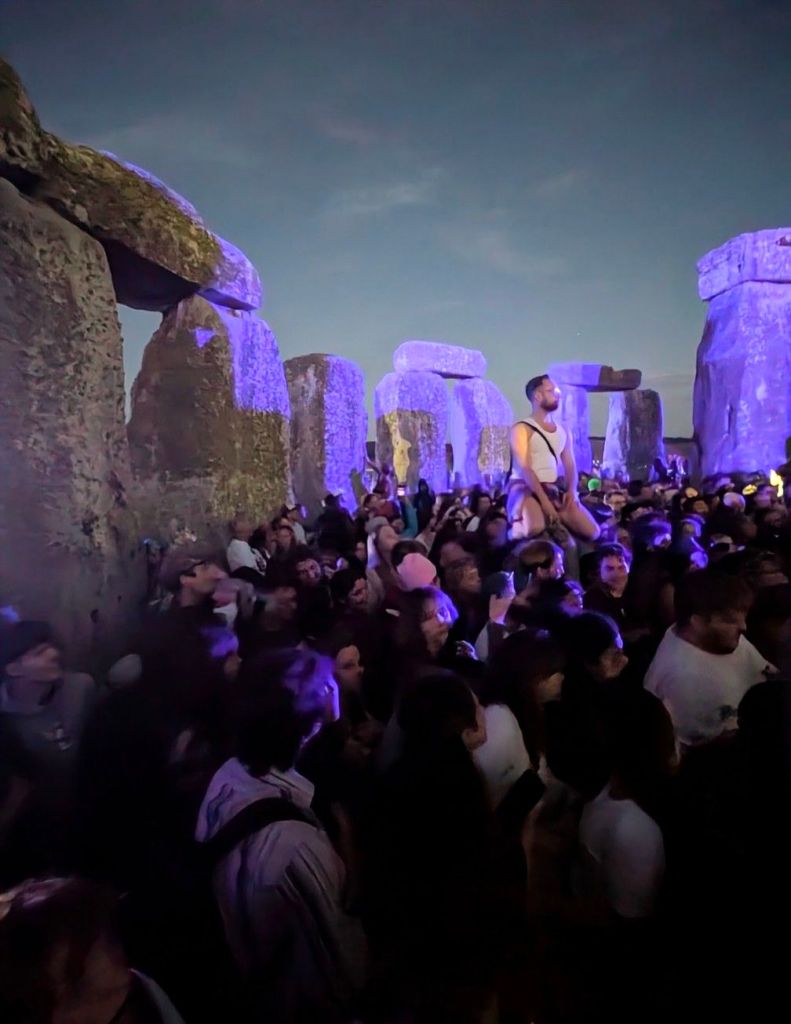
Inside the actual stone circle there was a group of drummers playing. I would have loved to have got closer to watch them properly, but there were simply too many people packed around them.
English Heritage states people are not to stand or climb on the stones, although in reality there were people standing on some of the lower stones throughout the night.
Everywhere I looked there were people enjoying themselves. Families, groups of friends, people in ceremonial dress, people wrapped in blankets, people dancing, people drumming and people who had simply found themselves a little patch of grass and settled down beneath the stones for the night.
It was of course busy, noisy and crowded, but it was also incredibly atmospheric.
A Few Hours’ Sleep Before Sunrise
I already knew I wasn’t going to stay at the stones for the entire night. I was travelling on again the following day and didn’t particularly want to spend half of that day asleep in the Stonehenge car park trying to recover! And I’m not as young as I used to be so I do need a little bit of beauty sleep.
I’d arrived at the monument around sunset, which was somewhere around 9.30pm, and stayed until roughly midnight. By then I decided I needed to be sensible and get at least a few hours’ sleep, so this time I jumped on one of the shuttle buses and headed back to my campervan. One of the definite advantages of doing solstice at Stonehenge in a campervan is being able to climb straight into your own bed!
I managed a few hours’ sleep before my alarm went off at 3am. I made a coffee ( I definitely needed caffeine) and this time the ceremonial garb stayed firmly in the van. Warmth and comfort had become considerably more important! I threw on normal clothes, wrapped up and headed back out into the darkness to catch the shuttle bus to the stones again, ready for sunrise.
I got chatting to some people on the bus and discovered something quite interesting.
The official information for the solstice had said not to arrive at the car park before the designated opening time, ie, 7pm on the 20th June. However, the people I was speaking to told me they had actually arrived the previous night and had still been able to make their way to the stones. From what they described, there were already quite a few people gathering and things happening there well before the official arrival time.
If you can gain an extra night at Stonehenge, then go for it! Obviously, I stored that little piece of information away in my head for another time.
Sunrise at Stonehenge
I love a good sunrise or sunset at the best of times, and I watch them fairly regularly from Devon but one of the things I’ve always loved is that moment when a group of complete strangers watches the sun appear or disappear together. When I used to travel to Goa, I would often find myself sitting amongst groups of people on hilltops or beaches watching the sunset, and when the sun finally disappeared below the horizon, everyone would cheer.
There’s something wonderfully human about it. That connection that happens when complete strangers come together, when you’re all in alignment with one another.
We forget sometimes that a sunrise or a sunset is a cosmic event. It happens every single day of our lives, so we barely give it a thought. The Earth turns, the sun appears on the horizon, and we just carry on with whatever we’re doing, living our lives without giving it a second thought. But when you actually stop and watch it, particularly alongside hundreds or thousands of other people who have stopped to do exactly the same thing, you remember just how extraordinary it really is, solstice, equinox, or not!
For those few minutes, everyone is looking in the same direction. It doesn’t matter who you are, where you’ve come from or what your life looks like outside of that moment. You’re simply a group of human beings standing on this planet, watching the sun appear. That to me is so incredibly special. There’s something instinctive about it, something primal, something that feels so much older than any of us. Sunrise, sunset, moonrise and moonset are events which I believe we should all recognise and never just take for granted. This is not an event separate from us. We are it! Our place in the cosmic creation is divinity itself.
As the sun finally began to appear, the whole place erupted. People cheered and clapped, the drums were beaten, including my own, and suddenly thousands of people who had been waiting together in the slightly chilly early morning were celebrating the arrival of the sun.
It was beautiful.


And standing there, I felt incredibly appreciative of where I was.
I’ve visited Stonehenge many times over the years. I’ve walked the surrounding landscape, I’ve stayed nearby in my campervan and I’ve seen the stones in different seasons and different weather. But this felt completely different.
Even the walk towards Stonehenge had felt special. You’re not simply walking towards an old monument. You’re crossing a landscape that people have been walking through, gathering in and attaching meaning to for thousands of years. That’s incredible, right? To walk in the path of our ancestors is everything!
And then there are the stones themselves.
No matter how many times I see Stonehenge, I still look at it and think: how the hell did they do this?
Some of the smaller bluestones were brought all the way from the Preseli Hills in South West Wales, more than 150 miles away! That was over four thousand years ago. We still don’t know exactly how they transported them, and standing there looking at those enormous stones makes the achievement difficult to comprehend.
But seeing Stonehenge at sunrise on the summer solstice added another dimension to it.
The monument was deliberately aligned with the movements of the sun at the solstices. At midsummer, the sun rises at the north-eastern end of that alignment; at midwinter, the setting sun marks the opposite direction.
So there we were, thousands of years later, still gathering in the same landscape and still turning towards the sun and I think that was the part that affected me most.
For a little while, it didn’t matter that there were thousands of people around me, or that I hadn’t managed to get the perfect view of the Heel Stone, or that I’d been awake since three o’clock in the morning.
I just felt incredible gratitide that the life I’m living in this incarnation allowed me to be there.
Of course, this being 2026, there were mobile phones and selfie sticks everywhere. Ho hum. People were filming, photographing, trying to find the best angle and capture the perfect shot, and I was no exception. I wanted my photographs and videos too!
There are those that reject that entirely, to put away the tech and just ‘be there in the moment ‘. But actually, I don’t think that takes anything away from it.
This is simply how we experience and record our lives now, and that’s fine.
Five thousand years ago, people came to this landscape and looked towards the sun. Today we come carrying smartphones and selfie sticks. The details have changed, but the remarkable thing is that we are still coming. Generations upon generations, we still flock to this sacred site and that’s what should matter, not the changing tides of time.
Thousands of years later, people are still making the journey to these stones. We are still gathering together. We are still watching the sky. We are still trying, in our own modern way, to connect with something much bigger and much more ancient than ourselves.
So if that means there are thousands of mobile phones held in the air when the sun appears, then so what?
The phones aren’t the story.
The fact that we’re still coming, is.
The Walk Back
After sunrise, I decided it was time to head back to the van and continue my journey towards Gloucestershire.
I could easily have jumped on one of the shuttle buses, but somehow I didn’t want to. I’d started the experience by walking across the landscape towards Stonehenge, and I wanted to finish it in the same way.
So I walked.
By now the morning was beginning to warm up, and I took off my shoes and walked barefoot through the grass.
I love walking barefoot whenever I can. There’s something about feeling the earth directly beneath my feet that immediately grounds me and brings me back into the moment and after everything I’d just experienced, it felt like exactly the right way to make that final journey back.
The grass was still cold beneath my feet as I walked, and I became really conscious of every step. It became a meditative practice. After the noise, the energy of the stones, the thousands of people, the drums, the chanting and that huge eruption of cheering as the sun appeared, the walk back gave me time to quietly absorb it all.
Of course, there’s always something particularly special about walking barefoot across this landscape.
These are ancient lands. People have walked across them for thousands of years, long before our roads and our cars and visitor centres existed. Feeling the earth beneath my feet made me feel connected to this incredible place itself. I may have had my phone at sunrise, but being present in the land on my walk back to my van, rather than rushing through it, meant everything to me, appreciating what I’d seen and where I’d been.
Although that walk back did seem to go on forever!
It was obviously exactly the same distance I’d walked the night before, but somehow it felt twice as long. Perhaps it was because I was tired after only a few hours’ sleep, or perhaps the anticipation that had carried me towards the stones the previous evening had disappeared. Whatever the reason, the Visitor Centre seemed to take a very long time to come back into view.
Eventually, though, I reached the car park and my campervan and that was it. Eighteen years after my last summer solstice at Stonehenge, I’d finally done it again.
I packed up the van and continued my journey towards Gloucestershire, tired but incredibly grateful for what I’d just experienced.
My next stop was an equine assisted soul experience in Minchinhampton near Stroud, something completely different, and another experience in itself.
But that is a story for another blog post.
Merry Summer Solstice 2026, everyone.

 The Wander Room
Leave a comment